Sidelights and toplights: more daylight without losing your privacy
A sidelight or toplight can turn a dark hallway into a bright one, but glass beside your front door raises an obvious question: can the street see in? Here is what each glazing option actually does.
Written by the Kilgate Doors team, with figures from the manufacturer's documentation and our installer's practice.
Czytaj po polsku →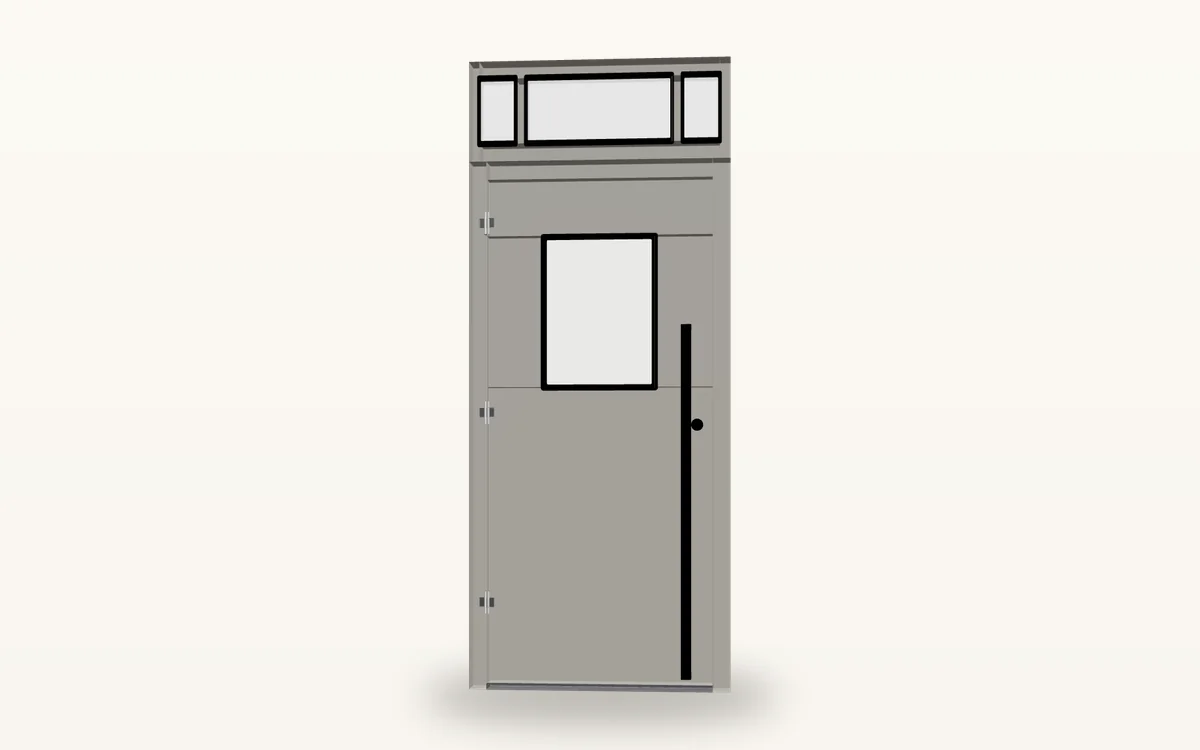
Most Irish hallways get their only daylight from the front door itself, and a solid or lightly glazed leaf does not throw much of it past the mat. A sidelight or a toplight changes that: more light in the hall in the morning, less reason to flick the hall light on at four in the afternoon in November. The question that comes up straight after is privacy, because glass next to your door usually faces the street, the driveway, or a neighbour's window.
Here is what the layouts and the glass options actually do, honestly, including the one that people expect to work harder than it does.
What layouts are possible
A sidelight is a narrow glazed panel built into the frame beside the door leaf. A toplight sits above it. Both can be combined, within limits set by the frame construction rather than by taste.
| Layout | What it adds | Typical use |
|---|---|---|
| One sidelight (left or right) | Light down one side of the hallway | Porches with room on one side only |
| Two sidelights | Light on both sides of the opening | Wide openings, semi-detached and detached porches |
| Toplight only | Light from above, no loss of wall privacy at eye level | Narrow openings, terraced houses close to the path |
| Sidelight plus toplight | Light from the side and above | Openings with height and width to spare |
| Two sidelights plus toplight | Maximum daylight, a full glazed surround | Wide, tall openings, usually detached houses |
The narrowest a sidelight can be made is 26 cm. Standard widths run from there up to 50 cm; anything from 51 cm to a metre is possible but has to be quoted individually rather than picked off a standard list. The frame around the glass takes roughly 11 cm out of the panel width, so a 26 cm sidelight shows about 15 cm of actual glass. That sounds narrow on paper and reads as a bright vertical strip in the hallway once it is in.
The full surround, two sidelights and a toplight together, is capped at a combined width of around 40 cm of sidelight per side once a toplight is added. It is the most glass you can put around a door, and it is also the layout where the privacy question matters most, because it is glazing on three sides rather than one.
The glazing options, and what each one actually does for privacy
The glass in a sidelight or toplight is not automatically clear. Three options come at no extra cost: a bronze-tinted reflective glass, a frosted ("milk") glass, and plain clear glass. Beyond those, a one-way mirror finish, a printed pattern, a graphite tint and a black glass are available as upgrades, priced at survey once we know the size and count of the panels involved, because the wholesale glass pricing changed in September and we would rather quote it properly than print a number we are not sure of.
Frosted glass blurs shape and colour evenly in both directions, day and night. It is the safest choice if privacy is the main reason you are adding glass at all, and it costs nothing extra.
Bronze reflex glass tints the light slightly warm and works as a mild one-way mirror in daylight, when it is brighter outside than inside your hall. At night, with the hall light on and it dark outside, that reverses: anyone outside can see in more clearly than you can see out. It is included at no extra cost and looks better than frosted glass to a lot of people, but it is not a night-time privacy solution.
The dedicated one-way mirror glass is a stronger version of the same effect. It works well in daylight and is charged per element, meaning a door plus one sidelight is two charges, not one. Read the name literally: it is a mirror effect that depends on which side has more light, not a permanent one-way glass. Turn the hall light on after dark and the effect is gone. Anyone selling it as full-time privacy glass is not describing it accurately.
Printed glass, a house number, a name, or a pattern etched into the surface, obscures the view in the printed area without acting as a privacy measure across the whole panel. People choose it for how it looks rather than for what it hides.
If your genuine concern is a hallway visible from the street after dark, frosted glass is the honest answer, not the mirror finish.
The trade-off with heat
Every pane you add is also a pane the heat can move through. A door on its own, glazed, declares a U value of 1.1 W/m²K. Add sidelights and the whole assembly is declared at 1.3 W/m²K. Both numbers clear the SEAI grant threshold of 1.4, so a full glazed surround does not put the grant at risk, but it is worth knowing that more glass means a slightly less efficient door, not a more efficient one. We have gone through that arithmetic in detail here, including why it matters less than people assume.
What it costs
Sidelights, toplights and the extra glass finishes are priced at survey rather than off a fixed list at the moment, because the manufacturer increased wholesale prices in September and we are not going to quote a number we would then have to walk back. What we can tell you without a survey: the layout options above, the minimum sizes, and which glass finishes are included at no charge.
Seeing it before you commit
A sidelight looks different on a screen than it does beside your own door, at your own height, in your own light. The fastest way to check is to build the layout in our 3D configurator and turn it, or send us your opening on a short WhatsApp video call and we will talk you through what will and will not work with the space you have.