Aluminium, composite or uPVC: what those words actually mean
Composite describes a €900 door and a €3,000 door equally well. Here is what is inside each type, what fails first, and the three questions that separate a good door from a bad one at any price.
Written by the Kilgate Doors team, with figures from the manufacturer's documentation and our installer's practice.
Czytaj po polsku →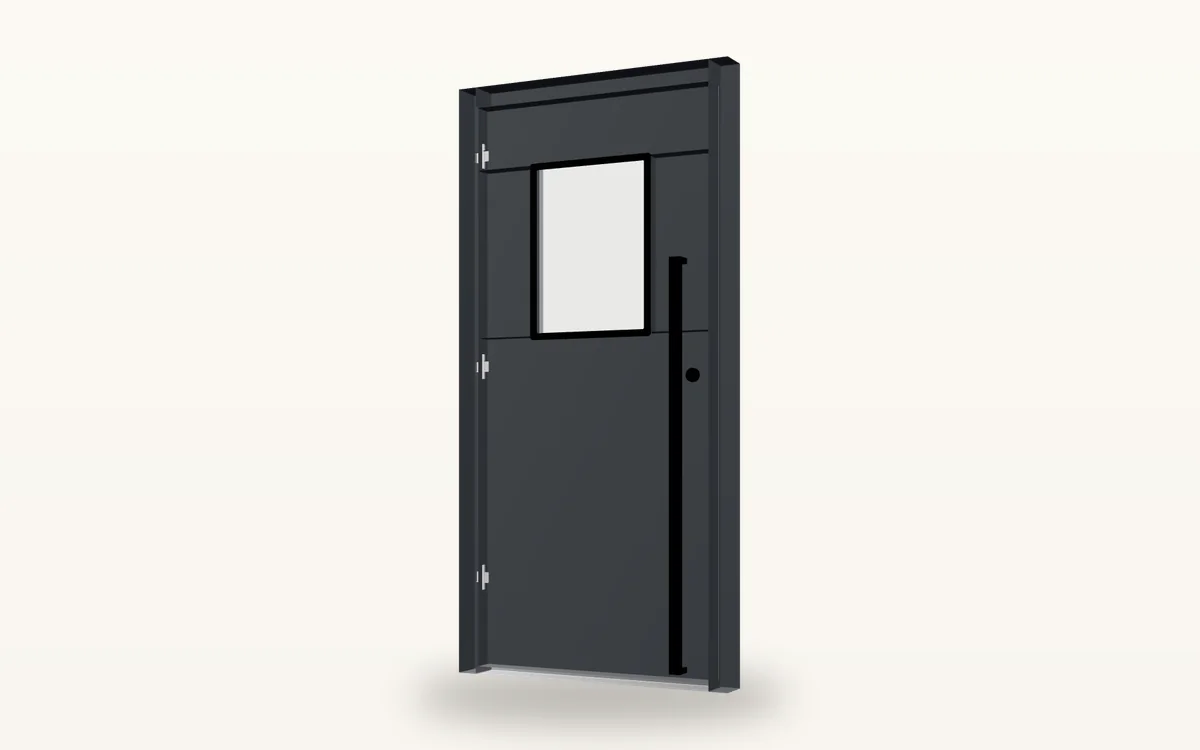
Three words do most of the work in door advertising in Ireland, and two of them tell you almost nothing on their own.
uPVC
If you want the numbers for the one door we sell rather than the categories, the specification page lists the leaf build, U values and air class in one place.
A hollow plastic extrusion divided into chambers, usually with a steel or aluminium reinforcement running inside the frame. The colour is either through-dyed white or a foil wrapped onto the outside. Cheap to make, cheap to fit, thermally fine on paper.
Where it fails is the leaf. A door leaf is a large flat panel that is warm on one side and cold on the other, and plastic moves. Dark foils on a south or west facing door are the worst case, because the surface gets far hotter than the air around it. You do not notice it as warping, you notice it as a door that used to close with one push and now needs a shoulder, because the leaf no longer meets the seal evenly along its length.
The second weak point is what the lock is screwed into. A multipoint lock is only as good as the material holding the keeps.
Composite
This is a category, not a specification. It covers any door built from more than one material, usually a glass reinforced plastic skin over an insulating core, sometimes with a timber sub-frame around the edge.
The spread inside that word is enormous. The core might be solid laminated timber, polyurethane foam, or expanded polystyrene. The skin might be 2 mm of GRP or a thin thermoplastic sheet. Two doors, both accurately described as composite, can differ threefold in price and by more than that in how long they stay square.
So the word on its own is not information. What is the core, what is the skin, and how thick is the leaf: those are information.
Aluminium
Also two different things sold under one word.
A full aluminium door is an extruded aluminium frame and leaf with a thermal break, which is a polyamide strip separating the outer metal from the inner metal. Thin sightlines, very stable, expensive, and the hardest of the three to get right thermally. Aluminium conducts heat roughly a thousand times better than the foam sitting next to it, so everything depends on how well that break is designed.
The other kind, which is what we fit, is an insulated leaf in an aluminium frame. The leaf is 72 mm thick: a polyurethane core, a steel skin, and a leaf frame of ABS reinforced with glass fibre. The outer frame is a 90 mm thermally broken aluminium profile. You get the stability and the finish of aluminium on the parts exposed to weather, and an insulating core where the heat would otherwise walk out.
The three questions
Ask these about any door, from anyone.
| Question | Why it matters |
|---|---|
| How thick is the leaf, in millimetres? | Thickness is where insulation and rigidity both live. Under 50 mm you are buying an internal door with weather seals. |
| What is the declared U value for this door, in writing? | Not the brochure figure for the best case. The declared figure, from the Declaration of Performance. |
| What is the air permeability class? | Class 4 is the top of the scale under EN 12207. This is the number that decides whether the hall is draughty, and almost nobody quotes it. |
For what it is worth, ours are 72 mm, ≤0.89 W/m²K solid and ≤1.1 glazed as declared worst case, and class 4. Those are testable claims and you should hold every supplier to the same standard, including us.
What actually matters on an Irish elevation
Wind driven rain, mostly. A door that performs beautifully in a laboratory in central Europe meets a different problem on a west facing wall in Mayo in February.
The relevant numbers are watertightness and wind load, and they are on the same Declaration of Performance as the U value. Ours are tested to EN 14351-1 with a notified body, wind class 3/C and watertightness 6B. Ask for the equivalent and you will find out quickly how seriously a supplier takes documentation.
The other coastal factor is fixings. Foils and anodised aluminium hold up in salt air. Untreated steel screws and hinge pins do not, and they are invisible on the day of installation.
The honest bit
If your budget is €1,200 fitted, uPVC is not a scandal. It is the correct answer to the money you have, and a well made uPVC door beats a badly made composite one every time.
The argument for spending more starts at the point where the door is on an exposed elevation, or facing south with a dark colour, or carrying a lock you actually rely on. That is where leaf thickness, frame material and the air class stop being specification-sheet trivia and start being the difference between a door that still shuts properly in 2038 and one that does not.